If you’re planning to spend money on online advertising, two platforms usually come up first: Meta Ads and Google Ads.
Both can help businesses generate traffic, leads, sales and brand awareness. However, they work differently.
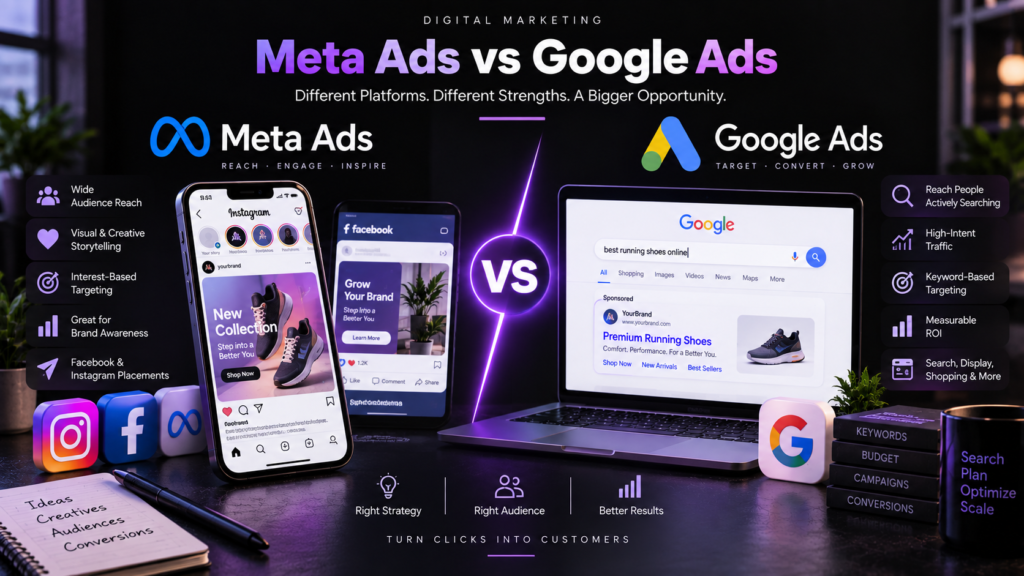
Google Ads can place your business in front of people who are actively searching for products or services. Meta Ads, which include advertising across Facebook and Instagram, can help businesses reach audiences based on factors such as interests, behaviour and other targeting signals.
So, Meta Ads vs Google Ads — which should you use?
The answer depends on your business, audience, objective, product and buying journey.
Let’s break down the differences.
What Are Google Ads?
Google Ads is Google’s advertising platform.
One of its most important formats is Search campaigns, where businesses can show ads when people search for relevant products or services. Google describes Search campaigns as a way to reach people actively searching for what you offer.
For example, imagine someone searches:
“best gym near me”
A local gym could potentially appear as a sponsored result.
This makes Google particularly useful when customers already know what they want and are actively looking for it.
Google Ads also includes other campaign types such as Display, Video, Shopping, Demand Gen and Performance Max.
How Google Ads Works
Google Ads uses factors such as keywords, targeting, bidding and Ad Rank to determine which ads are eligible to appear.
For Search campaigns, advertisers can select keywords that relate to the searches they want to target. Google then evaluates eligible ads through its auction system.
For example:
Search:
“buy running shoes online”
Potential advertiser:
Running shoe store
Goal:
Drive the searcher to a product page.
This is essentially demand capture — you’re reaching people who have already expressed an interest through their search.
What Are Meta Ads?
Meta Ads are advertisements delivered through Meta’s advertising ecosystem, including platforms such as Facebook and Instagram.
Unlike traditional Google Search advertising, Meta can introduce your product or service while people are browsing social content rather than actively searching for it.
That makes creative an important part of Meta advertising.
For example, a clothing brand could show someone:
- A product video
- A lifestyle image
- A Reel
- A carousel
- A creator-style advertisement
The person may not have searched for the product beforehand.
Instead, the advertisement creates awareness and interest.
Meta also provides different targeting and audience tools, including options involving existing customer data and custom audiences.
Meta’s current advertising ecosystem also uses automated systems such as Advantage+ across placements and creative optimisation.
Meta Ads vs Google Ads: Key Differences
The biggest difference isn’t simply the platform.
It’s how people discover your business.
1. Search Intent
Google Search generally captures existing demand.
Someone searches:
“digital marketing agency in Meerut”
They are already looking for a solution.
Your advertisement can appear when the search matches your targeting and campaign setup.
Meta works differently.
A person might be scrolling Instagram and see an advertisement for a digital marketing agency without searching for one.
So:
Google Ads → “I am looking for something.”
Meta Ads → “This looks interesting.”
Neither approach is automatically right for every business.
2. Targeting
Google Ads can use keywords and various targeting settings to connect ads with relevant searches. Advertisers can also refine campaigns using factors such as location, language and audiences.
Meta advertising can use audience signals and targeting options to help advertisers reach relevant groups. Meta also supports Custom Audiences and other audience approaches.
This creates two different approaches:
Google:
Target the demand people are expressing.
Meta:
Target and discover audiences that may be interested.
3. Creative Requirements
Google Search ads are primarily text-based.
Your headlines, descriptions, keywords and landing page need to work together.
Google also provides responsive search ads that can combine different headlines and descriptions to test different combinations.
Meta is much more visual.
Your performance can depend heavily on:
- Images
- Videos
- Reels
- Hooks
- Headlines
- Offers
- Product demonstrations
- Creative formats
For example, Meta specifically supports Reels advertising designed around vertical video and mobile consumption.
Therefore, businesses running Meta campaigns often need a stronger creative testing process.
4. Speed and Visibility
Paid advertising can provide visibility without waiting for organic rankings.
With Google Search, ads can appear when eligible searches occur.
With Meta, advertisements can also be delivered to selected audiences once campaigns are active and approved.
However, visibility does not automatically mean profitability.
A campaign still needs:
- The right audience
- Strong creative
- Relevant messaging
- A good landing page
- Proper tracking
- A sensible budget
- Continuous optimisation
Google itself recommends monitoring conversion-related metrics rather than focusing only on clicks.
5. Cost
There isn’t one universal answer to the question:
“Is Meta cheaper than Google?”
Costs can vary significantly depending on:
- Industry
- Competition
- Audience
- Location
- Campaign objective
- Creative
- Landing page
- Conversion rate
- Bidding strategy
- Budget
Google Search advertising commonly uses a pay-per-click model, while the broader advertising platforms offer different campaign and bidding approaches.
Therefore, comparing platforms using a single average CPC or CPM number can be misleading.
Instead, businesses should evaluate the cost of achieving the desired business outcome.
For example:
Campaign A
₹500 spent → 20 clicks → 2 leads
Campaign B
₹500 spent → 10 clicks → 4 leads
Campaign B generated fewer clicks but more leads.
That is why clicks alone shouldn’t determine campaign success.
Which Platform Should Your Business Use?
There is no universal platform that works for every business.
Instead, start with your customer journey.
Use Google Ads when:
Google can be particularly relevant when:
- People actively search for your product
- Your service solves a specific problem
- Search demand already exists
- You want to capture high-intent searches
- Your landing pages match specific search queries
Examples could include:
Plumber
“plumber near me”
Dentist
“dental clinic near me”
Digital agency
“digital marketing agency in Meerut”
E-commerce
“buy running shoes online”
In these situations, the customer’s search itself provides useful intent information.
Use Meta Ads when:
Meta can be particularly useful when:
- Your product is highly visual
- You need to create awareness
- Your audience spends significant time on social platforms
- You have strong creative assets
- You want to test different offers and messages
- You want to reach audiences before they actively search
Examples include:
- Fashion
- Beauty
- Fitness
- Food
- Lifestyle products
- D2C brands
- Events
- Creator-led products
Meta’s advertising formats can support visual storytelling across placements such as Facebook and Instagram.
Can You Use Meta Ads and Google Ads Together?
Absolutely.
In many customer journeys, the two platforms can serve different roles.
Imagine someone discovers a clothing brand through Instagram.
They don’t purchase immediately.
A few days later, they search:
“XYZ clothing brand”
The brand can potentially appear in Google Search when that person actively looks for it.
The journey could look like:
Meta Ads → Awareness → Website Visit → Consideration → Google Search → Purchase
This is why the platforms don’t necessarily need to compete with each other.
They can support different stages of the customer journey.
Common Mistakes Businesses Make
1. Choosing a platform because everyone uses it
A platform should match your audience and objective.
Don’t select Google simply because it is popular.
Don’t select Meta simply because your competitors are using Instagram.
Start with the customer journey.
2. Focusing only on clicks
Clicks are useful, but they aren’t the final business goal.
Depending on your business, you may care more about:
- Leads
- Purchases
- Revenue
- Qualified enquiries
- Calls
- Sign-ups
Google recommends using conversion tracking to understand the actions that matter to your business.
3. Sending every ad to the homepage
A campaign about one specific product should generally lead to a relevant page rather than forcing users to search through your entire website.
The closer the advertisement, landing page and customer intent are aligned, the easier the journey can be to understand.
4. Ignoring creative testing
Especially on Meta, one advertisement shouldn’t be treated as the final answer.
Test different:
- Hooks
- Visuals
- Offers
- Headlines
- CTAs
- Formats
Then use performance data to guide the next iteration.
Meta Ads vs Google Ads: The Bottom Line
Meta Ads and Google Ads solve different advertising problems.
Google Ads can help capture existing demand from people actively searching for products and services.
Meta Ads can help businesses reach audiences through social platforms using visual and engaging creative.
The right choice depends on your:
- Business model
- Customer journey
- Audience
- Product
- Marketing objective
- Creative resources
- Budget
- Conversion process
Instead of asking:
“Which platform is better?”
Ask:
“Where does my customer make decisions, and what do I need advertising to accomplish?”
That question gives you a much more useful starting point.
Ready to Build Your Paid Advertising Strategy?
At KalaaSync, we help businesses build digital strategies around their goals, from paid advertising and social media to SEO, websites and marketing automation.
If you’re unsure whether Google Ads, Meta Ads or a combination makes sense for your business, start with the customer journey and work backwards.
Need help planning your digital growth?