When someone searches for a product or service on Google, your business can appear in two major ways: through organic search results or through paid advertisements.
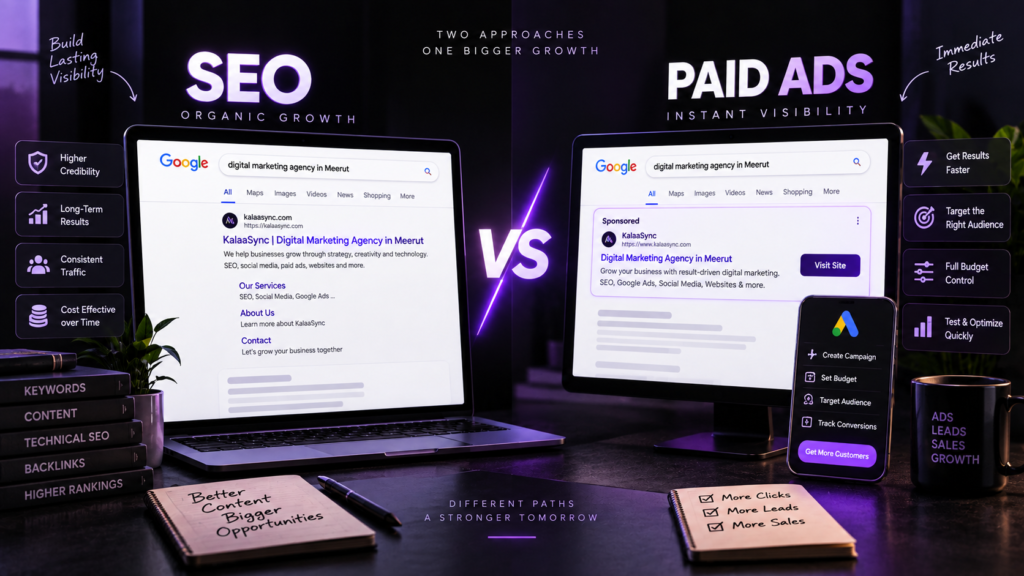
However, these two approaches work very differently.
SEO focuses on improving your website and content so that it can appear in relevant organic search results. Paid advertising, such as Google Ads, lets businesses pay to show advertisements for relevant searches and control campaign settings such as budget, targeting and keywords.
So, which one should your business use?
The answer depends on your goals, budget, industry, competition and timeline.
In this guide, we’ll compare SEO vs paid ads in simple terms. You’ll learn how each strategy works, what makes them different, when each approach makes sense and why some businesses can benefit from using both.
What Is SEO?
SEO, or Search Engine Optimization, is the process of improving your website and content so search engines can better understand and surface your pages for relevant searches.
Unlike paid advertising, organic search results are not advertisements. Google describes an organic search result as a free listing that appears because it is relevant to a user’s search.
How SEO Works
First, businesses identify topics and search terms that their potential customers use.
Then, they create useful content and optimize important parts of their website.
This can include:
- Keyword research
- Helpful website content
- Page titles and descriptions
- Internal linking
- Technical SEO
- Mobile usability
- Local SEO
- High-quality backlinks
- Content updates
As a result, search engines can better understand what your website is about and which searches your pages may be relevant to.
However, SEO is not simply about adding keywords to a page.
Google’s Search Central resources emphasize creating useful, accessible content and meeting technical requirements rather than trying to manipulate search rankings.
The Main Benefit of SEO
The biggest attraction of SEO is its potential to build long-term organic visibility.
For example, imagine you create a useful article that answers an important question your customers regularly search for.
If that page earns organic visibility, it can continue bringing relevant visitors without you paying for every individual click.
However, SEO requires patience. Competition, website quality, search demand and many other factors can influence how quickly organic visibility develops.
What Are Paid Ads?
Paid advertising works differently.
With Google Ads, businesses can create campaigns that allow their ads to appear when people search for relevant terms. Google uses an advertising auction to determine which eligible ads can appear and where they appear. Factors include the bid, ad quality, relevance, competition and other auction-time signals.
How Google Ads Works
First, you choose your campaign objective and targeting.
Then, you select relevant keywords or other targeting options depending on the campaign type.
After that, you create your advertisements and landing pages.
Finally, Google determines when eligible ads can appear based on the auction and other factors.
With CPC bidding, advertisers pay when someone clicks an ad. Google also allows businesses to set budgets and bidding strategies according to their campaign goals.
The Main Benefit of Paid Ads
Paid advertising can provide businesses with more immediate control over visibility.
For example, a local business launching a limited-time offer may not want to wait for organic rankings to develop.
Instead, it could create a targeted advertising campaign and send interested users to a relevant landing page.
This means paid ads can be particularly useful when a business needs to promote a product, service, offer or campaign within a specific timeframe.
SEO vs Paid Ads: What’s the Difference?
Now let’s compare the two strategies directly.
1. Speed
Paid ads can start generating visibility once campaigns are approved and eligible to run.
SEO generally takes longer because organic visibility depends on the website, content, competition and search engine evaluation.
Therefore, businesses with urgent campaigns may consider paid advertising, while businesses focused on building organic visibility can invest in SEO.
2. Cost
SEO and paid advertising have different cost structures.
With paid search advertising, you can pay for clicks depending on the bidding model you use. Your actual CPC can vary based on factors such as competition, ad quality, relevance and auction conditions.
SEO does not charge you a Google fee for every organic click.
However, SEO still requires investment.
You may spend money on content, technical improvements, tools, specialists or an agency.
So, “SEO is free” isn’t really an accurate way to think about it. Organic clicks don’t have a per-click advertising charge, but building and maintaining the work still requires resources.
3. Long-Term Value
SEO can create an asset in the form of useful content and a stronger website.
For example, a well-optimized service page may continue attracting relevant search traffic after it has been published.
Paid ads, on the other hand, generally depend on an active advertising campaign and budget.
As a result, SEO is often considered when the goal is long-term organic visibility, while paid advertising can be useful when immediate or controlled visibility is important.
4. Control
Paid advertising generally gives advertisers more direct control over campaign settings.
Google Ads allows advertisers to choose factors such as keywords, locations, budgets and bidding approaches.
Organic search doesn’t provide the same level of direct control over where and when a page ranks.
Instead, organic visibility depends on search engine systems and the relevance and quality of your website and content.
5. Testing
Paid advertising can also be useful for testing.
For example, a business can test different:
- Headlines
- Offers
- Keywords
- Audiences
- Landing pages
- Calls to action
Then, the business can use the resulting data to improve the campaign.
SEO can also provide valuable search and content insights, but the feedback loop is generally different.
Which Is Better for Your Business?
There isn’t one universal answer to SEO vs paid ads.
Instead, consider your situation.
Choose SEO When…
SEO may make sense when:
- You want long-term organic visibility.
- Your customers regularly search for your products or services.
- You want to build useful content around customer questions.
- You can invest consistently rather than expecting instant results.
- Your business operates in a market where organic search can generate relevant demand.
For example, a local service business could build pages around the services and locations its customers search for.
Over time, those pages can become part of the company’s organic search strategy.
Consider Paid Ads When…
Paid advertising may make sense when:
- You need visibility quickly.
- You have a specific offer or campaign.
- You want more control over targeting and budget.
- You want to test keywords or offers.
- You have a landing page designed to convert visitors.
- You can track leads or sales.
For example, an e-commerce business launching a seasonal product may use paid campaigns to reach potential customers during a specific period.
However, advertising alone won’t fix a weak offer, poor landing page or unclear positioning.
Can You Use SEO and Paid Ads Together?
Yes.
In fact, SEO and paid advertising don’t have to compete with each other.
They can support different parts of the same marketing strategy.
Imagine that you run a business selling professional services.
Your SEO strategy could target searches such as:
“digital marketing agency in Meerut”
Meanwhile, paid campaigns could target high-intent searches related to specific services.
As a result, organic and paid search can give you different opportunities to reach people at different stages of their journey.
Google itself notes that analyzing organic search results can also help advertisers identify potential keywords for Google Ads campaigns.
A Simple Combined Strategy
You could structure your approach like this:
SEO → Build long-term visibility
Paid Ads → Capture immediate demand
Landing Page → Convert visitors
Analytics → Measure results
Content → Build trust
Retargeting → Re-engage interested users
This creates a broader system rather than treating SEO and advertising as completely separate activities.
For businesses that need help connecting these channels, you can explore KalaaSync’s digital marketing services.
Common Mistakes Businesses Make
Treating SEO as Instant Marketing
SEO usually requires consistent work and patience.
Therefore, don’t expect a new website or article to immediately dominate competitive search results.
Running Ads Without Tracking
Getting clicks isn’t enough.
You should know what happens after the click.
For example:
- Did the visitor submit a form?
- Did they call?
- Did they purchase?
- Did they leave immediately?
Without conversion tracking, it becomes much harder to understand whether your advertising investment is producing useful business outcomes.
Google Ads supports conversion measurement for actions such as purchases, downloads and calls.
Sending Paid Traffic to a Poor Landing Page
Even a relevant advertisement can struggle if the landing page is confusing.
The page should clearly explain:
- What you’re offering
- Who it’s for
- Why it matters
- What the visitor should do next
Then, make the CTA easy to find.
Ignoring SEO Because You’re Running Ads
Paid advertising doesn’t replace organic visibility.
Similarly, SEO doesn’t necessarily replace paid campaigns.
Instead, consider what each channel can contribute to your overall strategy.
Final Takeaway: SEO vs Paid Ads
So, SEO vs paid ads — which should you invest in?
SEO can help businesses build long-term organic visibility, while paid advertising can provide more immediate and controllable access to relevant audiences.
SEO is particularly useful when you’re building a sustainable search presence.
Paid ads can be useful when you need targeted visibility, want to promote an offer or need faster campaign feedback.
However, you don’t always have to choose one.
A well-planned digital strategy can use SEO to build long-term visibility while paid advertising captures existing demand.
The right combination depends on your business model, customers, competition, budget and goals.
If you’re unsure where to start, first identify what your business needs most: long-term organic growth, immediate visibility, or a combination of both.
Then, build your strategy around that goal.
Want to see how these channels can fit into a broader growth strategy?