
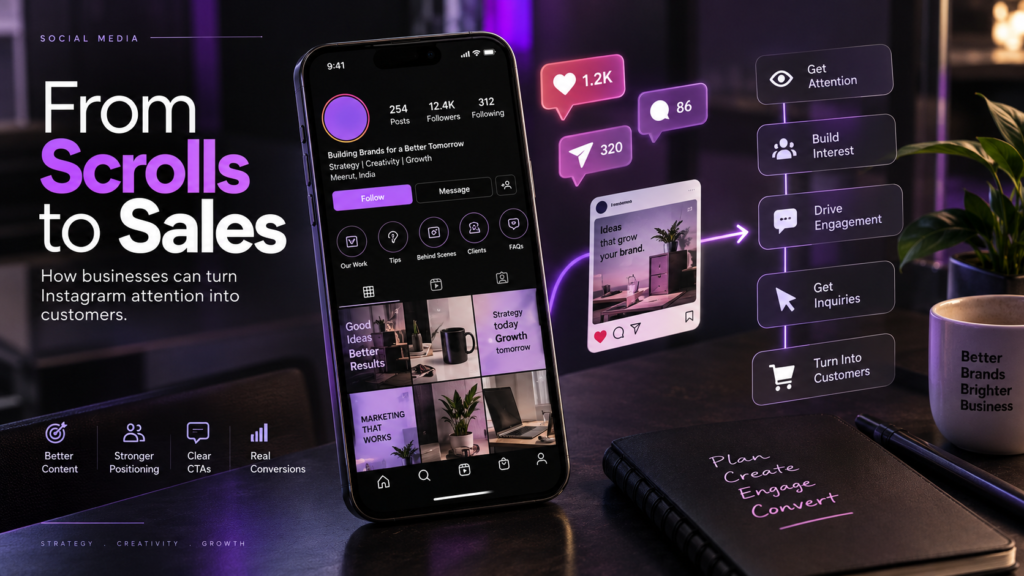
Getting views on Instagram feels good. However, views alone do not necessarily mean your business is growing.
A Reel can receive thousands of views without generating a single inquiry. Similarly, a post can get hundreds of likes while producing very few sales. So, the real question is not how to get attention on Instagram. It is how to turn that attention into action.
Instagram has become an important part of how people discover brands, products and businesses. In India, Meta reports that almost 8 in 10 shoppers discover products through social media, with 96% of those social discoveries happening on Meta platforms in the study it commissioned with GWI.
This means Instagram can play an important role in the customer journey. However, businesses need more than attractive posts. They need clear positioning, useful content, strong calls to action and a simple path from discovery to purchase.
In this guide, we’ll explain how businesses can use Instagram marketing to move people from simply watching your content to actually taking the next step.
1. Start With the Right Instagram Positioning
Before creating more content, you need to answer one simple question:
Why should someone follow or buy from your business?
If your Instagram profile tries to speak to everyone, it can become difficult for the right audience to understand what you actually offer.
Make Your Value Clear
First, make your Instagram bio immediately understandable.
A potential customer should be able to understand:
- What your business offers
- Who you help
- What makes your offer useful
- What they should do next
For example, instead of writing:
“Quality products. Best service. Since 2010.”
you could communicate something more specific:
“Premium custom furniture for modern homes.
Designed in Meerut. Delivered across North India.
↓ Explore our collection”
As a result, visitors have a clearer reason to continue exploring your profile.
Keep Your Brand Consistent
Next, make your visual identity consistent across your content.
Your colours, typography, photography style and tone should feel connected. This means someone should be able to recognize your content even before seeing your username.
However, consistency does not mean every post needs to look identical. Instead, create a recognizable visual system while allowing different content formats to perform their individual roles.
2. Create Content That Moves People Toward a Decision
Not every Instagram post should directly ask someone to buy.
In fact, a strong Instagram content strategy usually includes different types of content that help people at different stages of the buying journey.
Educational Content
First, create content that answers questions your potential customers already have.
For example:
- “How to choose the right running shoes”
- “5 mistakes businesses make with Google Ads”
- “What should you check before buying a property?”
- “How often should you service your car?”
Educational content can help establish your business as a useful source of information.
Then, connect that information naturally to your product or service.
Proof and Trust Content
Next, show people why they should trust your business.
This can include:
- Customer reviews
- Product demonstrations
- Before-and-after examples
- Behind-the-scenes content
- Case studies
- FAQs
- Founder or team content
- User-generated content
As a result, your audience gets more evidence before making a decision.
However, make sure testimonials and results are genuine. Avoid creating fake reviews, fake case studies or unsupported performance claims.
Product or Service Content
Finally, show what you actually sell.
Explain the problem your product solves, demonstrate how it works and make the value clear.
For example, a clothing brand could show how a product looks in different situations. Similarly, a digital marketing agency could explain how a landing page, SEO strategy or advertising campaign solves a specific business problem.
The goal is simple: don’t just show the product. Show why it matters.
3. Turn Attention Into Action With Better CTAs
A common Instagram mistake is creating content that gets attention but doesn’t tell people what to do next.
That’s where a call to action, or CTA, becomes important.
Use One Clear Next Step
Instead of ending every post with:
“What do you think?”
you can give people a more relevant action.
Depending on your objective, that could be:
- “DM us for the price.”
- “Visit our website to explore the collection.”
- “Book a consultation.”
- “Send us your requirements.”
- “Save this guide for later.”
- “Comment ‘GUIDE’ and we’ll send you the details.”
However, your CTA should match the purpose of the content.
If someone is seeing your brand for the first time, asking them to immediately purchase a high-value service may create too much friction.
Instead, ask for a smaller action first.
That might mean visiting your website, following your account, saving the post or sending a message.
Make the CTA Specific
A vague CTA creates uncertainty.
For example:
“Contact us today.”
is less informative than:
“DM us your business type and we’ll suggest the right marketing starting point.”
This means the customer knows exactly what information to provide and what happens next.
4. Build a Simple Path From Instagram to Purchase
Getting someone interested is only the beginning.
Next, you need to make the journey from Instagram to your business as simple as possible.
Think about the process:
Instagram content → Profile → CTA → Landing page/DM → Inquiry → Purchase
If one step creates unnecessary friction, people can drop off.
Optimize Your Instagram Profile
First, check your profile.
Make sure your:
- Bio explains your offer
- Profile image represents your brand
- Link works correctly
- Contact options are available
- Important information is easy to find
- Highlights answer common questions
Then, look at the destination you’re sending people to.
If you promote a specific service in a Reel but send people to a generic homepage, they may have to search for the information themselves.
Instead, send them to the most relevant page.
For example, if you’re promoting SEO services, direct the user to your SEO service page rather than making them search through your entire website.
For KalaaSync, visitors can explore the agency’s services through KalaaSync Services or contact the team through KalaaSync’s contact page.
Reduce Friction
The fewer unnecessary steps someone has to take, the easier it is to continue the journey.
For example, if your CTA says “DM us,” make sure someone is actually monitoring those messages.
Similarly, if your CTA sends users to a website, make sure the page loads properly on mobile and clearly explains what to do next.
5. Use Reels and Visual Content Strategically
Instagram is highly visual, so businesses need content that captures attention quickly.
Reels are particularly important because they are designed around short-form video and discovery. Meta’s own business resources describe Reels as a format businesses can use to connect with audiences and drive business objectives.
However, more Reels does not automatically mean more customers.
The creative still needs a purpose.
A Simple Reel Structure
Try this structure:
Hook → Problem → Solution → Proof → CTA
For example:
Hook: “Your Google Ads may be wasting money for one simple reason.”
Then explain the problem.
Next, show the solution.
After that, provide an example or proof point.
Finally, tell the viewer what to do next.
As a result, the Reel becomes more than entertainment. It becomes part of your conversion journey.
You can explore Meta’s official guidance for Instagram and Facebook Reels ads when planning paid campaigns.
6. Measure More Than Likes and Followers
Likes and followers can be useful indicators, but they aren’t the entire picture.
Instead, businesses should connect Instagram activity to meaningful actions.
Depending on your business, track:
- Profile visits
- Website clicks
- Link clicks
- DMs
- Leads
- Calls
- Form submissions
- Product inquiries
- Sales
- Cost per lead for paid campaigns
Look at the Full Journey
Suppose one Reel gets 50,000 views but produces two inquiries.
Another Reel gets 8,000 views but produces 20 qualified inquiries.
In that situation, the second piece of content may be more useful for a lead-generation goal, even though it received fewer views.
This is why businesses should avoid judging every piece of content only by reach.
Instead, connect content performance to the actual business objective.
Common Instagram Marketing Mistakes
Many businesses make the same mistakes repeatedly.
Posting Without a Strategy
Posting whenever someone has an idea can make your account inconsistent.
Instead, create content around clear themes and business objectives.
Focusing Only on Trends
Trends can help reach, but they should still make sense for your brand.
Otherwise, you may attract attention from people who have no interest in your product or service.
Using Weak CTAs
If people don’t know what to do after consuming your content, they may simply scroll away.
Therefore, give them a clear next step.
Sending Everyone to the Homepage
A generic destination can create unnecessary friction.
Instead, send users to the most relevant product, service or landing page.
Measuring Vanity Metrics Only
Followers and likes don’t tell the entire story.
Instead, monitor actions that connect Instagram activity to real business outcomes.
Final Takeaway: Attention Is Only the Beginning
Instagram can help businesses build awareness, create trust and reach potential customers. However, attention alone doesn’t create a reliable conversion system.
A stronger approach connects content, positioning, CTAs and the customer journey.
First, make your positioning clear. Then, create content that answers customer questions and builds trust. Next, give people a specific action to take. Finally, measure what happens after that action.
In other words, don’t ask only, “How many people saw this?”
Ask:
“What did they do next?”
That’s where Instagram marketing becomes more than a content channel. It becomes part of your broader digital growth system.
If you want to build a stronger social media strategy,